October 8, 2026
AI-Powered Drone Farming: What It Actually Means for UK Growers
By @y8p802z8gi
Walk any arable farm in the UK this spring and you will likely see a drone lifting off from a headland, mapping a winter wheat field before the sprayer even arrives. That sight would have been rare five years ago. Now it is becoming as normal as checking soil moisture. The shift is not just about having a clever gadget in the sky. It is about how artificial intelligence turns aerial data into decisions that save time, cut chemical use, and protect yields.
For growers who are used to walking fields with a trowel and a notebook, the idea of AI-powered drone farming can sound like something from a tech expo rather than a practical tool. But the reality is more grounded. The technology has matured to the point where it fits into an ordinary working week, not a research project. Understanding what it does, where it helps, and where it still has limits is the key to using it well.
From Pretty Pictures to Useful Data
The first thing most people notice about a drone flight is the imagery. Multispectral imaging captures light beyond what the human eye can see, picking up stress in plants days before it shows as discolouration. That is genuinely useful, but it is only the start. The real value comes when that imagery is processed through algorithms that turn raw reflectance values into something a farm manager can act on.
Take variable rate application as an example. Instead of spreading nitrogen evenly across a field, the drone data can create a map that tells the spreader to apply more where the crop is thin and less where it is thick. This is not guesswork. The system uses historical yield data, soil analysis, and current vegetation indices to build a prescription. The result is often a measurable reduction in input costs and a smaller environmental footprint, which matters more as regulations tighten.
For many UK growers, the entry point is field mapping. A single flight can produce a detailed topographic map that feeds into a geographic information system. That map then layers with drainage patterns, soil type boundaries, and previous crop performance. It gives a farm business a planning tool that was previously only available to large estates with dedicated agronomists.
Spraying and Spreading with Precision
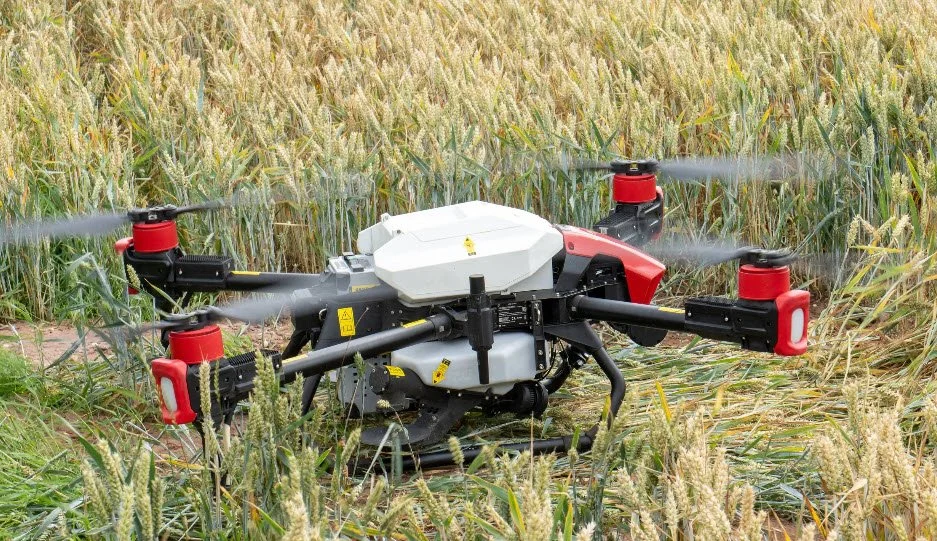
Drone spraying has moved from novelty to practicality, especially on farms with awkward fields, steep slopes, or wet conditions that keep heavy machinery out. The DJI Agras series has become a familiar name in this space. These are not hobbyist machines. They carry meaningful payloads, have obstacle avoidance, and fly on pre-planned routes with GPS guidance. When used well, they can apply pesticides or fertilisers with remarkable accuracy.
One of the quiet advantages of drone spraying is the reduction in pesticide use. Because the drone flies lower and slower than a manned aircraft, it can target the crop canopy more precisely. Drift is reduced, and the operator can adjust the spray pattern on the fly. This is not just a cost saving. It aligns with the push toward sustainable farming, a priority for the National Farmers' Union and many supply chains that now ask for evidence of responsible input use.
Autonomous flight is where the technology really changes the job. Once a field is mapped and a mission is set, the drone can follow the route without constant stick input. The operator monitors the screen and steps in if something looks wrong. This reduces fatigue and makes it possible to cover more ground in a day. But it also raises questions about battery life and the need for multiple batteries or charging systems, which is a practical consideration that any grower must plan for.
What AI Actually Adds
It is worth being clear about what the AI part of AI-powered drone farming does. The drone itself is not thinking. The intelligence sits in the software that processes the data and in the algorithms that turn images into recommendations. For example, a multispectral image can show where a crop is stressed, but it takes a trained model to distinguish between nitrogen deficiency, water stress, and disease pressure. That is where the AI earns its keep.
Yield prediction is another area where AI is making strides. By combining drone imagery with weather data and soil moisture sensors, models can forecast yield with surprising accuracy. This is useful not only for harvest planning but also for marketing. Knowing what you are likely to produce months ahead can influence forward contracts and storage decisions.
Crop health monitoring is perhaps the most immediate benefit. Regular flights across the season create a time series that shows how the crop is developing. A sudden change in the vegetation index can flag a problem early, before it spreads. Early detection is often the difference between a minor issue and a significant loss. For a busy farm manager, having that information without walking every field every week is a genuine advantage.
Battery Life, Swarms, and the Practical Middle
No honest discussion of drone farming avoids the constraints. Battery life is still the biggest operational limit. Most agricultural drones fly for 10 to 30 minutes per charge, depending on payload and wind. That means a large field requires multiple batteries and a charging strategy. Some operators carry a generator or use solar charging stations. It adds logistics, but it is manageable with planning.
Swarm technology is often talked about as the future. Multiple drones flying together could cover a field in a fraction of the time of a single machine. The concept is real, and some systems are already in limited use. But the regulatory environment in the UK is still catching up. The Civil Aviation Authority requires specific permissions for beyond visual line of sight operations, and flying multiple drones adds complexity. It is likely to come, but it will not be tomorrow.
Regulatory compliance is not just a bureaucratic hurdle. It is also a safety framework that protects people, livestock, and other aircraft. Any grower considering drone use should start by understanding the rules, which vary depending on the drone's weight and the operation's purpose. The good news is that training courses and certification schemes are well established, and the cost has come down as the industry has grown.
Getting Started Without Overcommitting
For a farm business, the sensible path is often to start with a service provider rather than buying equipment outright. Many agricultural service companies now offer drone spreading and spraying as a contracted service. That lets you test the value on your own fields without a large capital outlay. You can compare the results against your usual practice and decide if the investment in your own system makes sense.
When you do move to ownership, think about the whole system, not just the drone. Software subscriptions, maintenance, spare parts, and training all add cost. But the potential savings are real. One grower I spoke to reduced his herbicide use by 15 percent in the first season by using variable rate application based on drone maps. That paid for the service contract and left money over.
The key is to treat AI-powered drone farming as a decision-support tool, not a replacement for agronomic judgment. The drone tells you where the problem is. You still need to decide what to do about it. That blend of human experience and machine precision is where the real gains are made.
UK Agriculture is at an interesting point. Input costs are high, weather patterns are less predictable, and the pressure to demonstrate sustainable practices is growing. Drones, combined with AI, offer a way to farm more precisely and with less waste. They are not a silver bullet, but they are a practical tool that is already earning its place in many farm businesses.
The next few years will likely see more integration between drone data and farm management software, making it easier to move from map to action. Battery technology will improve, and regulations will evolve. But the fundamentals are already here. The farms that embrace this technology with a clear head and a realistic plan will be the ones that see the benefit.
In the end, AI-powered drone farming is not about replacing the farmer. It is about giving the farmer better information, faster, and in a form that fits the workflow. That is a quiet revolution, and it is happening now, field by field, across the UK.
❧